
Thunder Bay’s roads are the worst they’ve been in years. Here’s what you need to know if you’re injured.
Know Your Rights
Thunder Bay’s roads are the worst they’ve been in years.
Here’s what you need to know if you’re injured.
By Jeffrey J. Moorley | April 10, 2026 | White Macgillivray Lester LLP
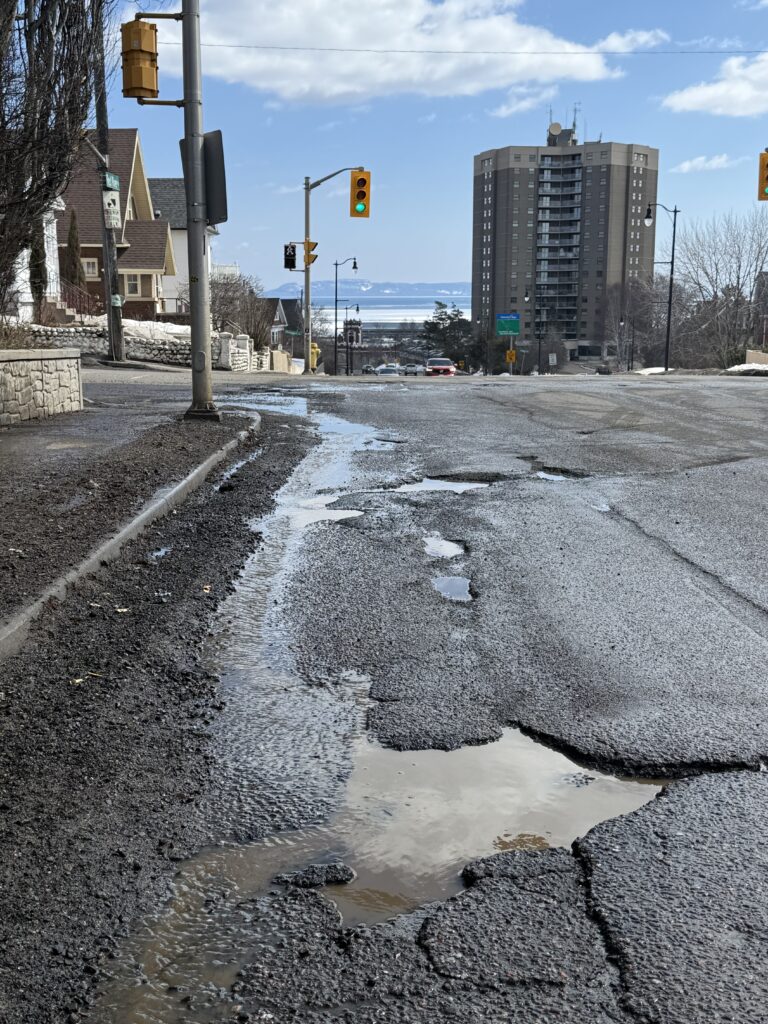
If you’ve driven — or walked — anywhere in Thunder Bay in the last few weeks, you already know. The roads are bad. Really bad. The freeze-thaw cycles this winter have torn up streets across the city, and the potholes this spring are deeper, wider, and more numerous than most of us can remember.
The City of Thunder Bay has confirmed it is receiving a higher than usual volume of pothole-related claims this year — 36 claims between January and late March alone. Local repair shops are reporting a surge in vehicles coming in with blown tires, bent rims, and broken suspension. A local driving instructor recently told CBC the roads are “the worst that I have seen.”
Most people know they can file a claim with the city for vehicle damage caused by a pothole. But what many people don’t realize is that potholes and road defects cause serious personal injuries every spring — to drivers, cyclists, and pedestrians — and that the rules for pursuing a claim depend on where the injury happens.
Potholes don’t just damage cars. They injure people.
We tend to think of potholes as a vehicle problem — a bent rim, a flat tire, a trip to the mechanic. But when potholes are severe enough, they cause real injuries. A sudden, violent jolt from hitting a deep pothole at speed can cause:
- Neck and back injuries — including disc herniations and aggravation of pre-existing spinal conditions
- Concussions — particularly when an occupant’s head strikes the window, headrest, or roof
- Wrist and hand injuries — from gripping the steering wheel at the moment of impact or falling on an outstretched hand
- Loss of vehicle control — leading to collisions with other vehicles, curbs, poles, or pedestrians
Cyclists and motorcyclists are especially vulnerable — a pothole that a car can absorb may throw a cyclist from their bike entirely, causing fractures, road rash, head injuries, and worse.
Pedestrians: the risk most people overlook
This time of year, it’s not just drivers who are at risk. Pedestrians trip and fall in potholes and broken pavement every day in Thunder Bay — and the injuries can be serious, particularly for older adults.
The most common places we see these injuries:
Crosswalks and intersections
Crosswalks are often where pavement deterioration is worst — heavy traffic, turning vehicles, and snowplow damage create crumbling surfaces, raised edges, and deep depressions that catch pedestrians mid-stride. A trip at a crosswalk can mean a broken wrist, a hip fracture, or a head injury from hitting the pavement.
Private parking lots
Shopping centre parking lots, grocery store lots, restaurant and bar parking areas — many private lots in Thunder Bay are in terrible condition this spring. Cracked asphalt, crumbling curbs, and potholes filled with standing water that hides the depth are hazards for anyone on foot, especially when carrying bags or navigating in the dark.
Sidewalks
Heaved and cracked sidewalks from frost damage are a tripping hazard throughout the city. Uneven surfaces that were hidden under snow all winter are now exposed — but not always obvious, especially at night or when partially covered by meltwater.
Commercial entrances
The transition between a parking lot and a store entrance — where asphalt meets concrete, where drainage grates sit, where curb cuts have crumbled — is a common fall location. Property owners have an obligation to keep these areas safe for customers.
The rules are different depending on where you’re injured
This is where it gets important. If you’re injured by a road or sidewalk defect in Thunder Bay, the legal rules — and the deadlines — depend on whether the property is public or private.
City streets, sidewalks, and crosswalks: the 10-day rule
If you are injured because of a defect on a city road, sidewalk, or crosswalk, you should provide written notice to the City Clerk’s office within 10 days.
This requirement comes from subsection 44(10) of the Municipal Act, 2001. If you miss this deadline, your claim against the city may be at risk — even if the city was clearly at fault. There are limited exceptions where a court can grant relief, but they are narrow and not something you want to rely on. Ten days goes by fast, especially when you’re dealing with injuries.
The City of Thunder Bay has a legal obligation under the Municipal Act to keep its roads and sidewalks in a reasonable state of repair. When the city fails to meet the minimum maintenance standards set out in Ontario Regulation 239/02, and someone is injured as a result, the city can be held liable for damages.
When potholes are as widespread and severe as they are right now — when the city itself acknowledges a higher than usual volume of claims, when repair shops are overflowing, and when driving instructors are afraid to use certain lanes — the conditions speak for themselves.
Private parking lots and commercial properties: occupiers’ liability
If you trip and fall in a private parking lot, on the walkway leading to a store, or on any other privately owned property, the claim is different. It falls under Ontario’s Occupiers’ Liability Act, which requires property owners and occupiers to take reasonable care to ensure their premises are safe for visitors.
The 10-day notice rule does not apply to private property claims. The standard two-year limitation period applies. But that does not mean you should wait. Evidence disappears quickly — the pothole that tripped you may be patched within days, and without photographs and documentation, proving your claim becomes much harder.
The bottom line: If you’re injured on a city road or sidewalk, the clock is ticking — provide notice within 10 days. If you’re injured on private property, you have more time, but the sooner you document the scene and get legal advice, the stronger your position will be.
What about vehicle damage only?
If your vehicle is damaged by a pothole but you are not physically injured, that is a property damage claim. You can file a claim directly with the city. The process is straightforward: photograph the pothole immediately, note the exact location, date, and time, save your repair receipts, and submit a written claim to the City Clerk’s office. Information about how to file is available on the City of Thunder Bay’s website. For vehicle damage only, you generally do not need a lawyer.
You should also check your own auto insurance policy. Depending on your coverage, your insurer may cover repairs — and may provide greater compensation than you can recover from the city.
What to do if you’re injured
Get medical attention. Even if the injury seems minor at first. Neck and back injuries from sudden jolts, and wrist or hip injuries from falls, often worsen in the days after the incident.
Document everything immediately. Photograph the pothole or road defect from multiple angles — get close-ups showing depth and size, and wider shots showing the location. If it is on a city road or sidewalk, note the street name and nearest intersection. If it is in a parking lot, note the business name and the specific location within the lot. If there are witnesses, get their names and contact information. Photograph any visible injuries.
If it happened on a city road or sidewalk: provide written notice to the City Clerk within 10 days. The notice should include the date, time, and location, and a description of what happened. If you are unsure how to do this, contact a lawyer immediately — we can help you get the notice filed properly and on time.
If it happened on private property: document and preserve the evidence. Photograph the hazard before it gets repaired. Report the incident to the property owner or manager and ask for a written record of the report. Keep a copy of everything.
Keep a record of how the injury affects you. Pain levels, missed work, activities you can no longer do, medical appointments. This documentation is critical whether your claim is against the city or a private property owner.
Contact a personal injury lawyer. Claims involving road defects and property hazards — whether against municipalities or private occupiers — have specific legal requirements and defences that require expertise. A lawyer experienced in these claims can assess your situation, ensure the deadlines are met, and advise you on the best path forward.

Injured by a road defect or a fall? Talk to us.
At White Macgillivray Lester LLP, we handle claims for injuries caused by road defects, pothole damage, and falls on both public and private property across Northwestern Ontario. We understand the notice requirements and limitation periods, and we can move quickly to protect your rights. There is no cost for an initial consultation, and you do not pay us unless we recover compensation for you.
Call 807-344-1000 or reach out for a Free Consultation online.
Serving clients across Northwestern Ontario — from Sault Ste. Marie to Kenora.

Jeffrey J. Moorley
Partner, White Macgillivray Lester LLP
Aside from his time in Kingston for law school, Jeff has lived his entire life in Northwestern Ontario. He is the Northwest Director on the Ontario Trial Lawyers Association and was named Lakehead University’s Exceptional Alumni for 2024. Full bio →