
Most of Ontario’s accident benefits are now optional. Here’s what that means if you’re injured.
By Jeffrey J. Moorley | June 2026 | White Macgillivray Lester LLP
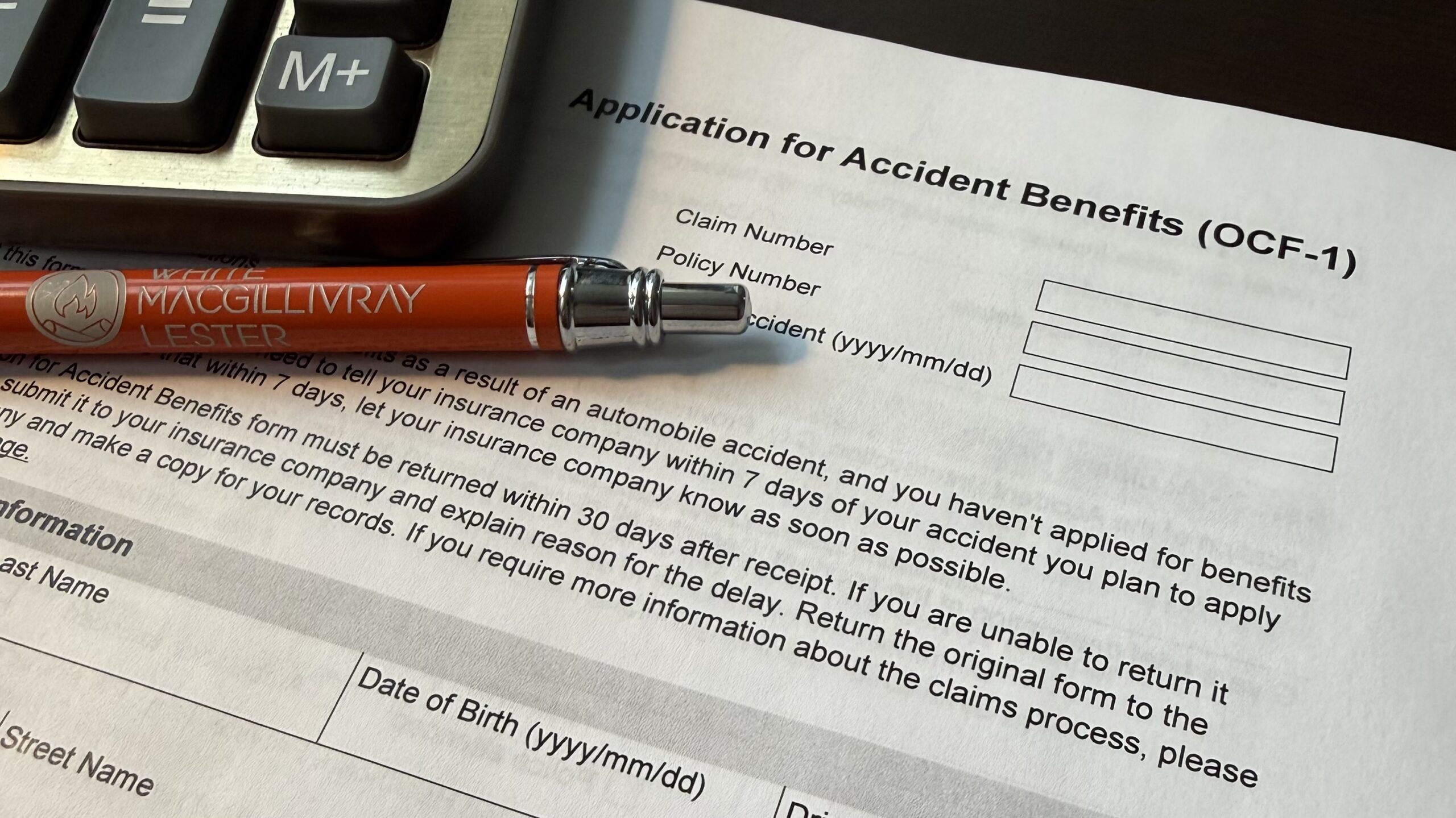
For decades, every auto insurance policy in Ontario came with the same safety net. If you were hurt in a collision, a standard package of accident benefits was there to help — with treatment, lost income, care for your family, and more — no matter who caused the crash.
That changed on July 1, 2026. Under Ontario Regulation 383/24, only three of those benefits are still guaranteed in every policy. Most of the rest are now optional — coverage you have to actively choose and pay for, or go without.
This isn’t a small adjustment. The choices made on a policy now determine what’s available if the worst happens, and two people injured in identical crashes can end up with very different support. Here’s a plain-language guide to what’s still automatic, what you now have to opt into, and — the part we care most about — what each benefit means if you’re injured without it.
A note before we start: decisions about what coverage to buy are best made with your insurance broker, who can look at your specific situation. Our role is different. We help people who have already been injured make the most of the coverage they have and pursue the claims available to them. This article is about understanding what’s at stake.
What’s still mandatory
Three benefits remain part of every Ontario auto policy:
- Medical benefits — treatment costs that OHIP doesn’t cover, like physiotherapy and other therapies.
- Rehabilitation benefits — services to help you recover and return to daily life and work.
- Attendant care — help with personal tasks like bathing and dressing when an injury makes them difficult.
The standard limits haven’t changed: $3,500 for injuries that fall under the Minor Injury Guideline, $65,000 combined for non-catastrophic injuries, and $1,000,000 for catastrophic injuries. That sounds like a lot — but for someone seriously hurt, the $65,000 non-catastrophic limit can be used up in a year to a year and a half once treatment and care add up. Even the mandatory coverage may not be enough, which is one reason the optional benefits matter.
What’s now optional
The following benefits used to be automatic. As of July 1, 2026, you have to choose them — and if you don’t, they won’t be there when you make a claim:
- Income replacement — replaces part of the income you lose if your injuries keep you from working (the standard benefit pays up to $400 a week). Without it: no automatic income support while you’re off the job, even though the bills don’t stop.
- Non-earner benefit — support for people who aren’t employed, such as students, when a crash seriously disrupts daily life. Without it: no benefit if you weren’t earning an income at the time.
- Caregiver benefit — covers the cost of care for a dependant — a child, or an aging parent — when an injury means you can no longer provide it. Without it: you cover replacement care out of pocket.
- Housekeeping and home maintenance — helps pay for the household tasks you can’t manage while injured. Without it: those costs fall to you.
- Death and funeral benefits — a payment to your family and help with funeral costs if a collision is fatal. Without it: no support from the auto policy in the worst case.
- Expenses of visitors — covers costs for family members who visit you during recovery. Without it: not covered.
- Lost educational expenses — reimburses tuition and materials if an injury derails your studies. Without it: no reimbursement.
- Damage to clothing and personal items — covers personal belongings damaged in the crash. Without it: not covered.
There is some good news on the choice front: caregiver and housekeeping benefits can now be purchased for non-catastrophic injuries, not only catastrophic ones, and higher limits and add-ons — supplementary medical and rehabilitation, dependant care, and indexation — are available for those who want more protection.
The part that catches people off guard
If you have an existing policy, you might assume nothing changes for you. That’s only half right.
Your current coverage and limits will carry over automatically when you renew, unless you agree in writing to change them. But who is covered for the newly optional benefits changed on July 1, 2026 — regardless of your renewal date. Optional benefits now apply only to the named insured, their spouse, dependants, and drivers specifically listed on the policy.
That has a real consequence for the most vulnerable people on the road. A pedestrian or cyclist struck by a car, or a passenger who doesn’t own the vehicle, used to be able to access these benefits through the involved vehicle’s policy. Now, as a “stranger” to that policy, they may not be eligible at all — unless they fall into one of those covered groups or have coverage of their own or through their household. If you walk or bike, it’s worth knowing whether anyone in your home carries auto insurance with optional benefits that would extend to you.
A change that actually helps
Not every part of the reform reduces protection. As of July 1, your auto insurer is now the first payer for medical and rehabilitation costs after a crash (other than medication), ahead of your workplace or private health plan. In the past, injured people often had to drain those other plans first. Now your auto coverage steps in upfront, preserving your workplace and private benefits for other needs. OHIP continues to cover hospital and physician care as always.
If you’re injured without the coverage
Here’s why this matters so much for the people we represent. As the no-fault benefits available through your own policy shrink, the claim against the at-fault driver becomes more important than ever. If you’ve lost income and don’t have income replacement coverage, or you’re facing care and housekeeping costs you can’t recover from your own insurer, a claim against the person responsible for the crash may be the main route to being made whole.
These claims are also more complex now, because what you can recover depends on the interplay between whatever benefits you do have and what you can claim from the at-fault party. There’s even a new endorsement (OPCF 47R) that changes which insurer an injured person can claim optional benefits from — a useful fix, but one more reason this system has become harder to navigate alone.
What to do
Before your next renewal, review your coverage with your broker. Ask what optional benefits are in your policy, what each costs, and what you’d be giving up by declining any of them. The premium difference is often modest compared to the protection at stake.
Check what you already have. You may have similar coverage through a workplace or private health plan — and now is the time to understand how it fits with your auto policy.
If you’ve been injured in a collision, talk to a personal injury lawyer. We can review your coverage, make sure you access every benefit you’re entitled to, and pursue a claim against the at-fault driver where one exists — which, under the new system, may matter more than ever.
Injured in a collision? Talk to us.
At White Macgillivray Lester LLP, we represent people seriously injured in motor vehicle collisions across Northwestern Ontario. We know the accident benefits system, including the changes that took effect on July 1, 2026, and we can help you access the coverage you have and pursue the claims available to you while you focus on getting better. We work on a contingency-fee basis — there is no cost for an initial consultation, and you do not pay legal fees unless we recover compensation for you.
Call 807-344-1000 or reach out for a free consultation online. Serving clients across Northwestern Ontario — from Sault Ste. Marie to Kenora.

Jeffrey J. Moorley
Partner, White Macgillivray Lester LLP
Aside from his time in Kingston for law school, Jeff has lived his entire life in Northwestern Ontario. He is the Northwest Director of the Ontario Trial Lawyers Association and was named Lakehead University’s Exceptional Alumni for 2024.
This article is provided for general information only and is not legal advice, and it is not advice about what insurance to purchase — that’s a conversation to have with a licensed insurance broker. Reading this does not create a lawyer-client relationship. If you’ve been injured, speak with a lawyer about your specific circumstances.