
Hurt in an ATV or Side-by-Side Crash? Where You Were Riding Changes Everything
By Jeffrey J. Moorley, Partner, White Macgillivray Lester LLP
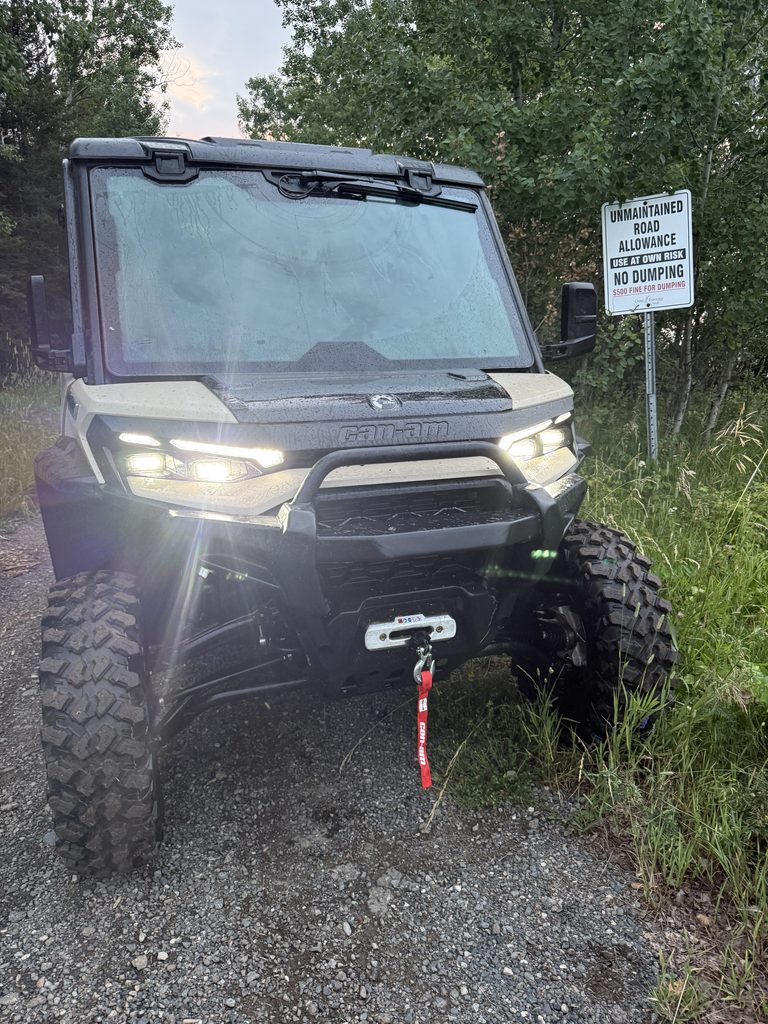
“Use at own risk.” Around Northwestern Ontario, you see those words at the start of plenty of bush roads and road allowances.
Take the warning seriously. But the sign alone does not tell you whether insurance can help after an ATV or side-by-side crash.
A rollover at camp can leave a family dealing with treatment, time off work and care at home. There may be accident benefits available even when no other vehicle was involved. There may also be a claim against someone who contributed to the crash.
The answer depends on the machine, its insurance, where it was being used and the injured person’s connection to the available policies. Here is what riders and families in the Thunder Bay area and across Northwestern Ontario need to know.
The essentials
- A single-vehicle crash can still lead to an insurance claim. You do not have to prove someone else was negligent to qualify for no-fault accident benefits.
- “Private property” does not settle the coverage question. Who owns the machine, who occupies the land and what the policies say all matter.
- Passengers need their own coverage check. Since July 1, 2026, being a passenger does not necessarily give you access to the driver’s optional benefits.
- Act promptly. Preserve the location and evidence, notify the insurer and get advice about deadlines.
Go directly to: What to do after a crash · Where you were riding · Passengers and the 2026 changes · Local road rules
Two different ways insurance may help
Accident benefits can help an eligible injured person with treatment, rehabilitation and personal care, regardless of fault. Other benefits depend on the coverage and eligibility rules. These are different from insurance that repairs or replaces the machine.
For injuries outside the Minor Injury Guideline, the standard combined medical, rehabilitation and attendant-care limit is generally $65,000, rising to $1 million for a qualifying catastrophic impairment. Optional coverage can increase those limits. Injuries within the Minor Injury Guideline generally have a $3,500 medical and rehabilitation limit. These are funding limits subject to eligibility and other rules, not automatic cash payments.
A claim against someone responsible for the injury may seek compensation for losses such as pain and suffering, lost income and future care. A passenger may have a claim against the driver. Depending on the evidence, a crash can also raise questions about the vehicle owner, repairs, a defective component or the condition of the route.
These two routes can operate together. Benefits, policy limits and the rules governing an automobile lawsuit affect what can be recovered. A serious injury does not automatically establish negligence, but “no other vehicle” does not mean “no possible lawsuit.”
Where you were riding matters—but it is not the whole answer
Section 15 of Ontario’s Off-Road Vehicles Act generally requires an off-road vehicle to have motor vehicle liability insurance. An important exception applies when it is driven on land occupied by the vehicle’s owner. “Occupied” is a legal concept broader than whose name is on the land title.
- Your ATV on a trail, Crown land or someone else’s camp property: insurance will generally be required. Permission to ride does not itself remove that requirement.
- Your ATV on land you occupy: the statutory exception may apply. That does not tell you whether an existing policy covers an injury.
- A borrowed ATV on your property: it is not enough that you occupy the land. The exception turns on the vehicle owner’s occupation of the land.
A vehicle that is required by Ontario law to have motor vehicle liability insurance can fall within the insurance-law definition of an “automobile.” That can open the door to statutory accident benefits. The incident must still meet the legal definition of an accident, and the claimant must satisfy the applicable eligibility rules.
If insurance was not legally required at that location, the policy wording and other available coverage still need to be examined. Do not accept either “it was private property, so there is no coverage” or “I insure my truck, so I must be covered” as a complete answer.
For a coverage review, gather the machine’s ownership and insurance documents, all potentially relevant household auto or ORV policies, and the exact location and route. Renting, borrowing, work use and unusual vehicle types can add further issues.
What a “use at own risk” sign does—and does not—tell you
A warning sign can matter to a claim about an unsafe road or trail. It does not, by itself, cancel accident benefits or answer every question about responsibility.
There are three separate questions: Were you permitted to ride there? Was insurance required or available? Did anyone owe and breach a duty concerning the route? A road can look like a bush trail while having a legal status that changes the analysis.
For a municipal road allowance, investigate whether it has been assumed for public use, its history and the applicable statutory protections. “Unmaintained,” “unopened” and “unassumed” are not interchangeable legal conclusions. A sign or a map label is a starting point, not the whole investigation.
Ontario’s Occupiers’ Liability Act can impose a reduced duty for qualifying recreational use of specified premises, including certain rural land and trails. When that rule applies, ordinary carelessness may be insufficient: deliberate harm or reckless disregard is the relevant standard. It does not follow that every trail operator, landowner or gravel-pit operator is automatically protected. The type of premises, permission, fees, activity and applicable law need to be checked.
Which insurer should receive the claim?
Start by identifying insurance under which the injured person is insured, including qualifying coverage through a spouse or parent. Ontario’s priority rules may direct the claim there before the policy on a borrowed machine. The ATV’s insurer is not automatically first in line.
The Insurance Act contains additional rules for people insured under more than one policy. Optional-benefit endorsements can also affect where a claim belongs. If no policy responds, the Motor Vehicle Accident Claims Fund may be a last resort for an eligible claim; it does not fill every coverage gap.
Tell the insurer about the injury promptly and ask for accident-benefit application forms. Keep a record of every insurer contacted and any written explanation that another insurer should respond. Get help if you are being passed back and forth.
Passengers: the July 2026 changes make this especially important
The changes effective July 1, 2026 apply to ORV policies too. Medical, rehabilitation and attendant care remain mandatory categories of accident-benefit coverage. Other categories, including income replacement, non-earner, caregiver, housekeeping, and death and funeral benefits, are now optional. Coverage limits and benefit-specific conditions still apply.
Existing coverage does not simply disappear at renewal. The transition rules generally continue the previous benefits and amounts unless the named insured agrees in writing to decline or change them.
But who can receive the optional benefits is a separate issue. They generally cover the named insured, their spouse, their dependants and their spouse’s dependants, and specified drivers. A friend riding along may qualify for mandatory benefits while having no entitlement to optional income replacement under that machine’s policy. Check the friend’s own and qualifying family coverage as well.
That is why “the side-by-side is insured” is only the start of the conversation. Read our guide to Ontario’s optional accident benefits and FSRA’s explanation of the transition and eligibility rules.
If a passenger has a negligence claim against a friend or family member, liability insurance may respond. However, exclusions, coverage disputes and losses above policy limits can create personal exposure. Have the coverage reviewed before assuming the insurer will pay everything.
What if the machine was uninsured?
Get advice before giving up. The machine’s lack of insurance does not necessarily eliminate every benefit or claim available to an injured person.
The consequences differ for an owner, driver and passenger. A driver who knew or reasonably should have known the automobile was uninsured can lose specified accident benefits. An owner or lessee who contravened the compulsory insurance requirement can also face a statutory bar to recovering injury damages. The rules are not a blanket denial of every benefit to everyone involved.
Before riding, ask your broker to confirm the coverage for the actual machine and its intended use. Do not assume a home, farm or truck policy provides the protection you need.
Road rules around Thunder Bay: check the actual route
A ride around Murillo, Rosslyn or Kakabeka Falls may involve a municipal road, private land and a provincial highway connection. Approval for one section does not establish permission for the next.
Oliver Paipoonge’s published By-law 13-2021 permits qualifying ORVs on municipal highways subject to provincial law and local restrictions. Its limits include:
- 20 km/h where the road’s posted limit is 50 km/h or less, and 40 km/h where it is higher.
- Riding only from 30 minutes before sunrise until 30 minutes after sunset.
- Prohibited municipal locations, including parks, recreational fields, landfill sites, community centre grounds, municipal gravel pits and Stanley Hill Cemetery, subject to the by-law’s municipal-work exception.
Confirm the current rules and closures with the municipality for your route. Oliver Paipoonge’s by-law does not authorize travel on provincial highways such as Highway 11/17, or decide what is permitted in Thunder Bay, Shuniah, Neebing, O’Connor, Conmee or Gillies. Crossing a highway and travelling along it are different questions. Check the precise location against Ontario’s ORV guidance and the applicable rules.
Kids, helmets and side-by-side passengers
A cab, doors and seatbelts do not remove the helmet requirement for ordinary on-road ORV riding. On roads where riding is permitted, provincial rules generally require drivers to be at least 16 with an appropriate licence, and prohibit passengers under eight. Side-by-side occupants must use the required seatbelts; other seating and vehicle requirements also apply.
Off-road rules differ. Follow the manufacturer’s age, size and seating restrictions as well as the law. A legal exception is not a safety recommendation, and an adult-sized machine is not made suitable for a child by adding supervision.
Wear an approved, properly fastened helmet, ride sober, use every required restraint and carry passengers only in seats designed for them. For remote rides, share your route and return time, save an offline map and plan how you would call for help without cellular service.
What to do after an ATV or side-by-side crash
- Get help and identify the location. Call 911 for a serious injury. Give the road or trail name, nearest access point and GPS coordinates if available. Follow emergency instructions.
- Report the injury collision to police. Contact the police service responsible for the location, which may be the OPP or a local service. Keep the occurrence number.
- Preserve evidence safely. Record the precise crash location, direction of travel, signs, washouts, gates and other conditions. Save original photos, GPS tracks, messages and witness contact details. Do not put anyone at risk to collect evidence.
- Preserve the machine and equipment. Before repairs, disposal or alterations, arrange an opportunity to document or inspect relevant damage. Keep helmets, restraints, parts and purchase or service records where they may matter.
- Identify the people and policies. Record the driver, owner, passengers, licence plate or VIN, landowner or occupier, and available auto and ORV insurance.
- Notify the insurer and track the losses. Ask for the accident-benefit application. Keep medical records, receipts, treatment travel expenses, time-off-work information and a record of help needed at home.
- Have any denial and urgent deadline reviewed. Get the insurer’s reasons in writing. An adjuster’s answer is not necessarily the final legal answer.
For families in rural Northwestern Ontario, recovery can mean travel to Thunder Bay or farther away, time off work for a caregiver, and treatment that is not available close to home. Keep records of those practical costs so their recoverability can be assessed.
Do not wait for the paperwork to sort itself out
- Accident-benefit notice: generally within seven days after the circumstances giving rise to entitlement, or as soon as practicable afterwards.
- Application: generally within 30 days after receiving the forms. If you are late, still seek advice: a reasonable explanation can matter.
- Municipal road claims: some require formal written notice within just 10 days. Exceptions exist, but a police report or ordinary complaint is not a substitute for checking the statutory notice requirements.
- Lawsuits: the general Ontario limitation period is two years from discovery of the claim, subject to exceptions. Other notices and insurance-dispute deadlines can arise much sooner.
If the injured person is a child, lacks capacity, or a family member has died, obtain advice about the specific rules rather than calculating a deadline yourself.
Before the next ride: five questions for your broker
- Does this policy cover this machine and how I actually use it—at camp, on trails, on permitted roads or for work?
- What liability limit do I have, and what protection is available if another responsible driver is uninsured or underinsured?
- Which accident benefits are included, and what would help replace income or fund care after a serious injury?
- Who qualifies for those benefits when a spouse, child, friend or borrowed-machine driver is injured?
- What exclusions, driver restrictions and changes should I know about? Please confirm the answers in writing.
Local help after a serious off-road injury
White Macgillivray Lester LLP represents injured people and families across Northwestern Ontario, including Thunder Bay and surrounding rural communities, Nipigon, Marathon, Greenstone, Dryden, Sioux Lookout, Fort Frances and Kenora.
We can investigate the available insurance, the circumstances of the crash and potential claims. If you have them, bring the policies, photographs, police occurrence number and any denial letter. You do not need to have every answer before contacting us.
Call 807-344-1000 or request a free consultation. We will explain the next steps and any proposed fee arrangement.
Sources and further reading
- Off-Road Vehicles Act — insurance, occupation of land and safety requirements.
- Insurance Act — automobile definition, insurer priority and restrictions on claims.
- Statutory Accident Benefits Schedule, O. Reg. 34/10 — eligibility, benefits, exclusions and application requirements.
- FSRA: After an Accident—Understanding the Claims Process.
- Occupiers’ Liability Act and Municipal Act, 2001 — land and road claims.
- Limitations Act, 2002 — limitation periods.
- O. Reg. 316/03 and Oliver Paipoonge By-law 13-2021 — on-road operation.

Jeffrey J. Moorley
Partner, White Macgillivray Lester LLP
Aside from his time in Kingston for law school, Jeff has lived his entire life in Northwestern Ontario. He is the Northwest Director on the Ontario Trial Lawyers Association and was a recipient of a Lakehead University Alumni Award in 2024. Full bio →
This guide provides general information about Ontario law as of September 25, 2026. It is not legal advice and does not create a lawyer-client relationship. Coverage and legal rights depend on the facts, policy wording and applicable law.